Here are some of my favorite sensory memories of reading manga in the early aughts:
The sound of smooth jazz over the Borders intercom. The taste of Jelly Belly jellybeans. The numbing stiffness after using a step stool as a chair for three hours. That bold text at the end of a volume screaming at me to turn back to the front of the book.
You know, like this:
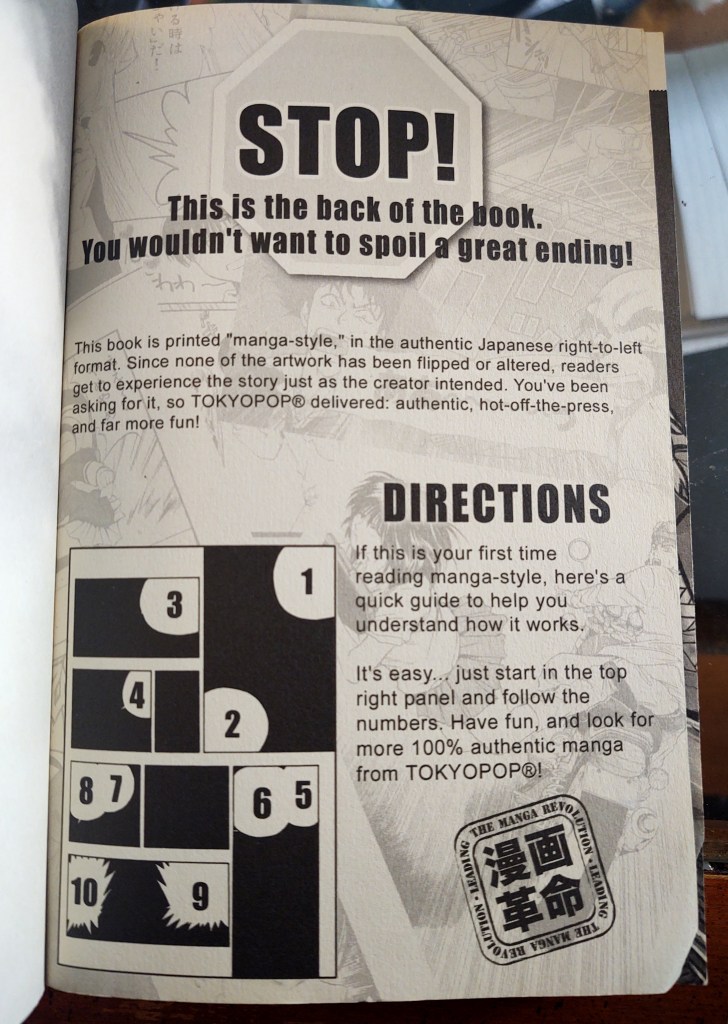
When I got back into manga as an adult, I knew that my reading experience was going to be different from my teenage days. (Especially the Jelly Belly part – way too sweet.) There were more publishers now. Readers were growing up, and these publishers had to consider how much cultural context their audiences already had and what kinds of licenses they were going to want.
Still, I was a bit surprised at how I was no longer being shouted at whenever I finished a volume. Kodansha USA used to include back matter warnings but dropped them some time between 2013 and 2017. Yen Press, too, does not include the alert.
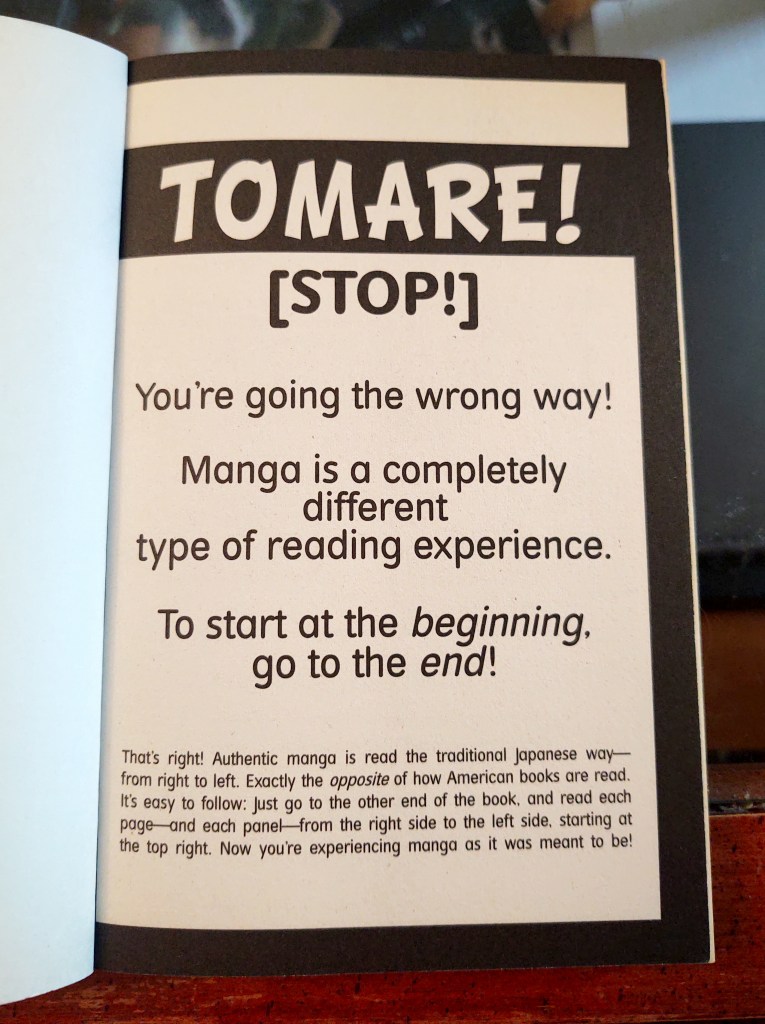
Arisa vol. 2 (Kodansha, 2011) 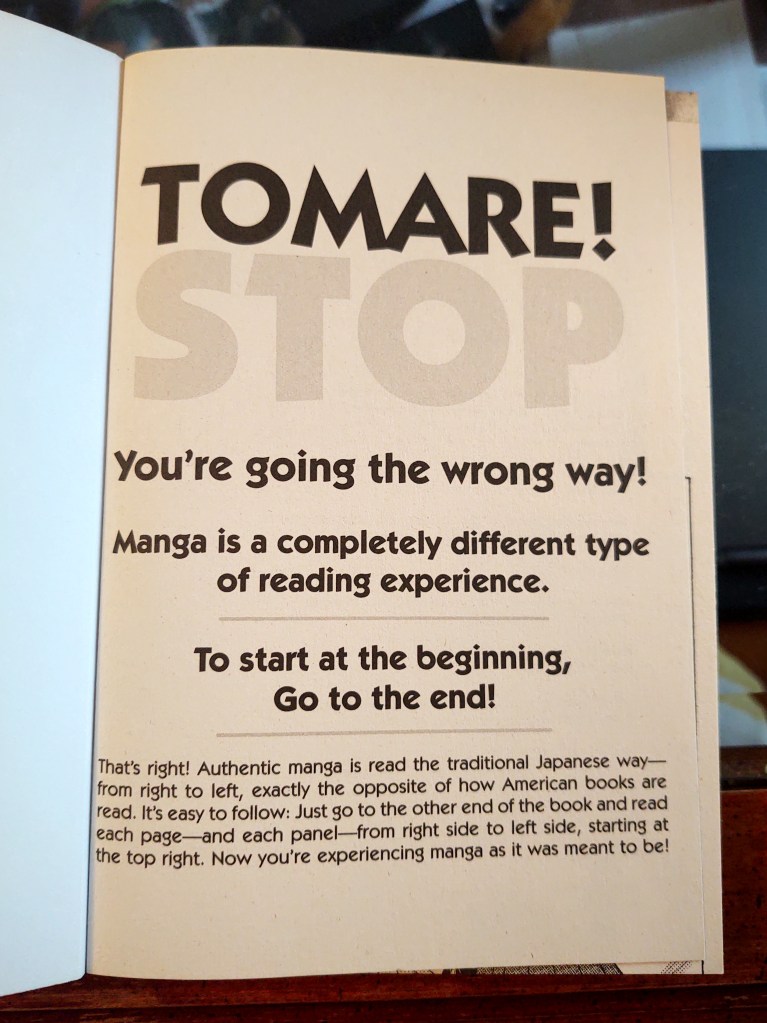
Sailor Moon vol. 1 (Kodansha, 2011)
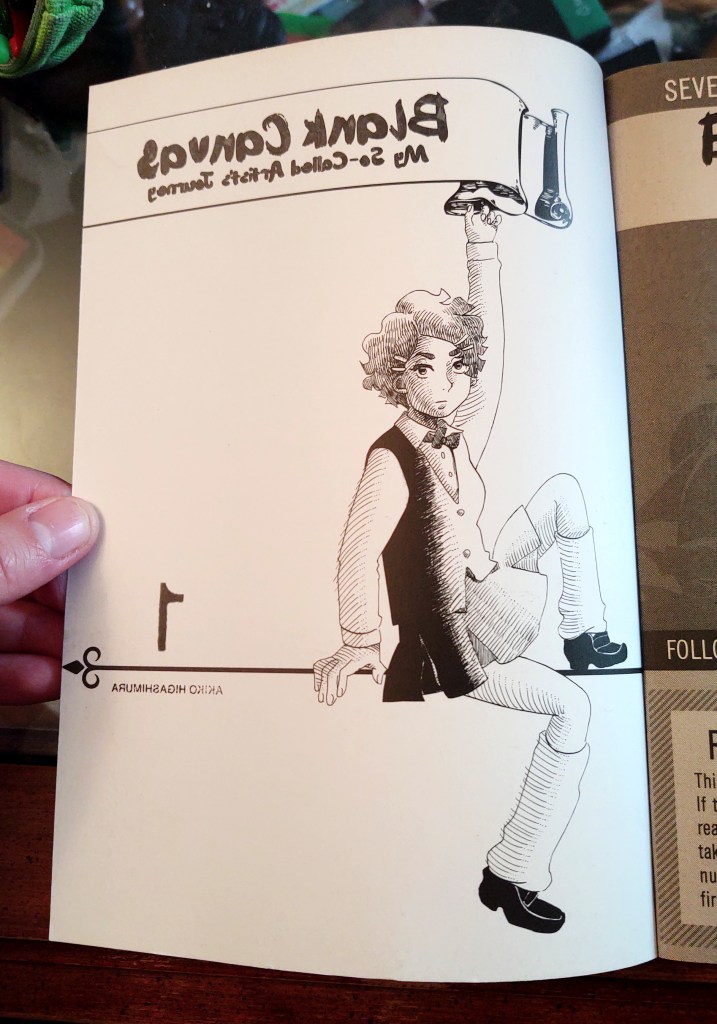
Seven Seas does include a warning but has integrated it into their publication info. Their polite version is neatly tucked into the bottom third of the page. This layout is standard across series with very little graphic variance aside from the title logo, although I must give a shout out to the addition to the Blank Canvas inside covers — a mirrored illustration, as if alluding to how starting at this end of the book would be “backwards.”
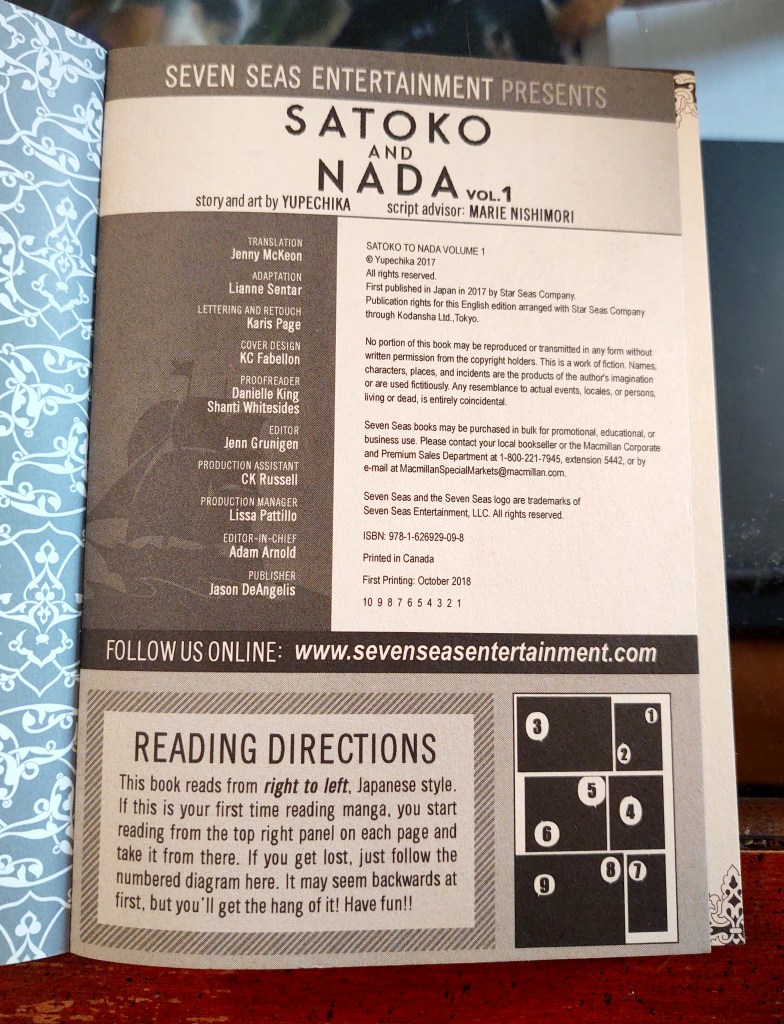
I think these approaches say something about how Kodansha and Yen Press view their readers: well-read manga fans revisiting new editions of old favorites or searching for a new title in their favorite sub genre. Which, in comparison, makes TokyoPop and Viz Media’s treatments of the back page warning stunning.
See, Viz and TokyoPop were early aughts contemporaries. Most millennial manga readers were first introduced to the form and taught how to read it by one of these publishers. TokyoPop’s approach to the warning hasn’t changed much since their revival:
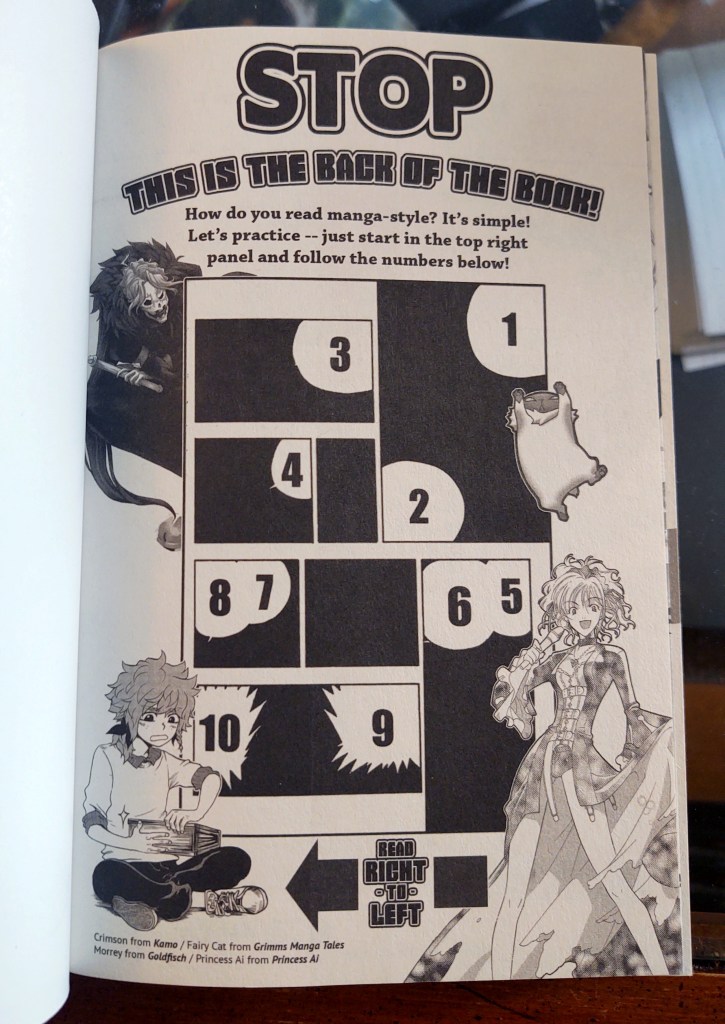
They’ve lightened up on the text in favor of title promotion, but the panel reading guide and bold font (albeit a bubblier typeface) are still there.
Viz Media, though, does not take a one-size-fits all approach. Back in the early aughts, they might have slapped their warning on the inside back of cover, added character art, and changed up the typeface to fit the mood of the series.
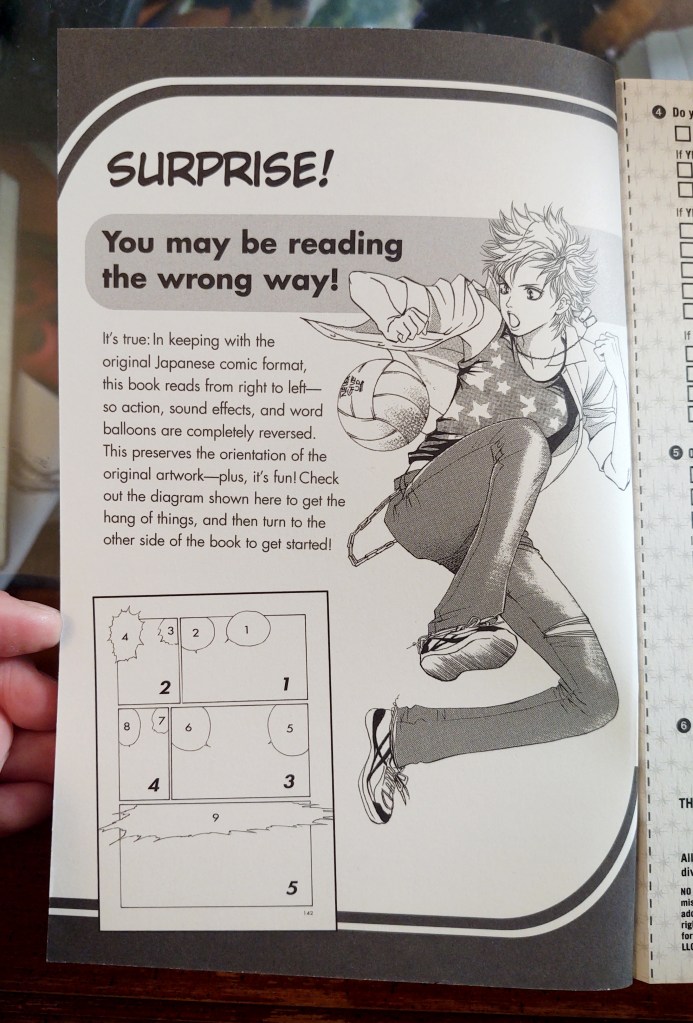
Crimson Hero (2005) 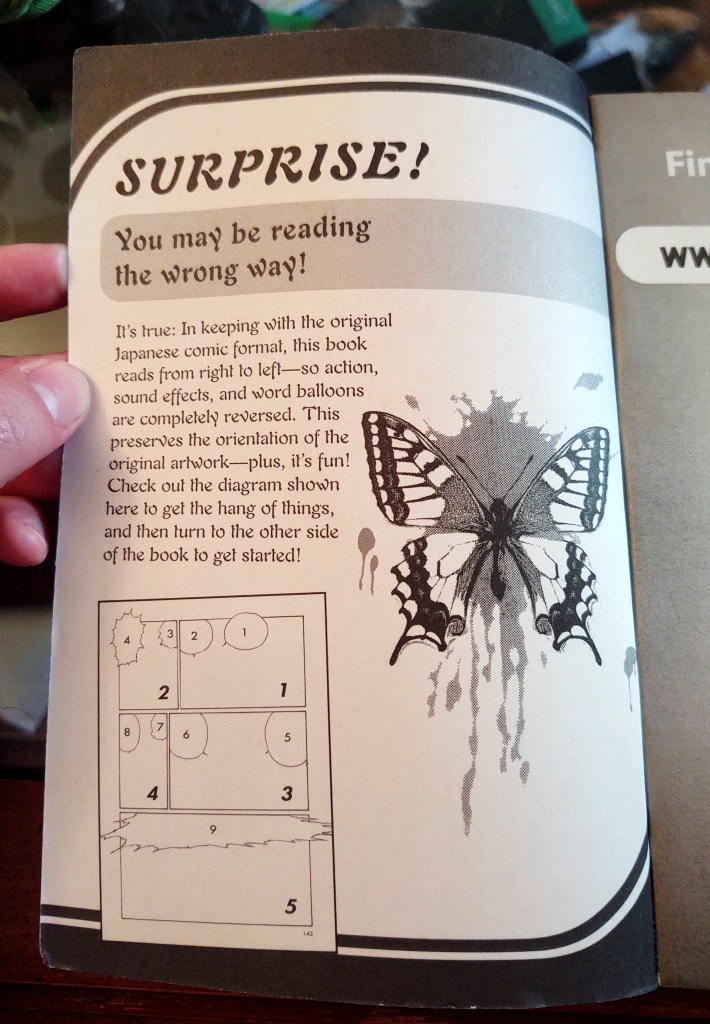
Fairy Cube (2008)
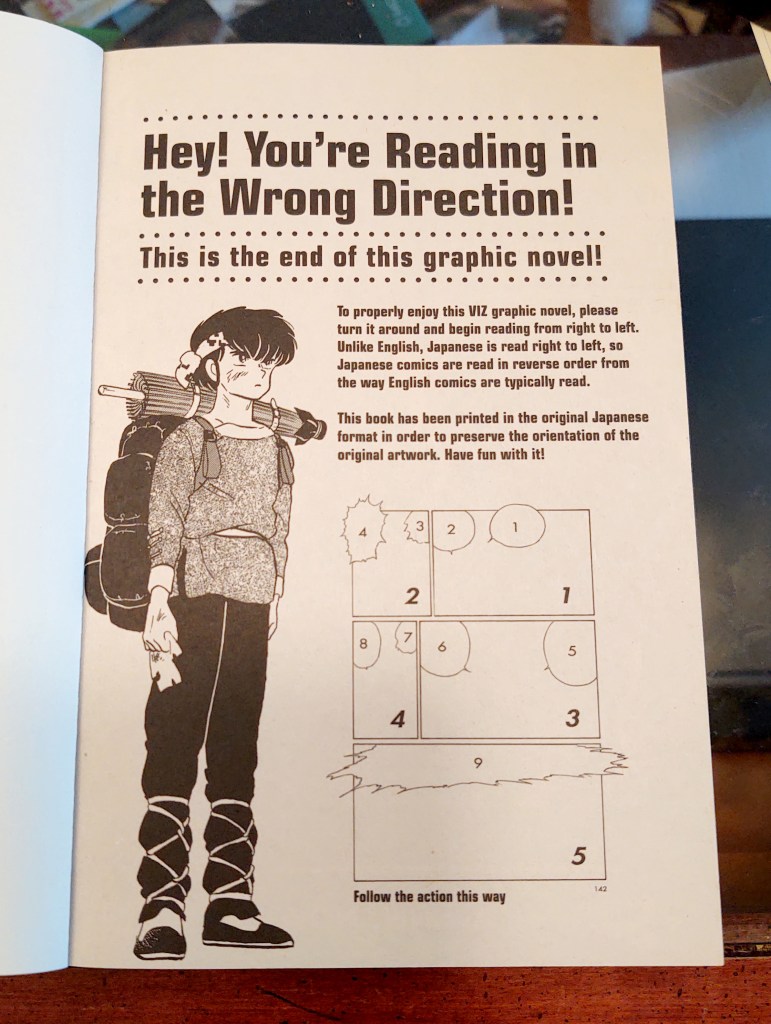
By the mid-2010s, Viz’s warnings had started to get a bit witty. The first volume of the Ranma ½ omnibus (2014) features Ryoga Hibiki, a character known to have an extremely poor sense of direction.
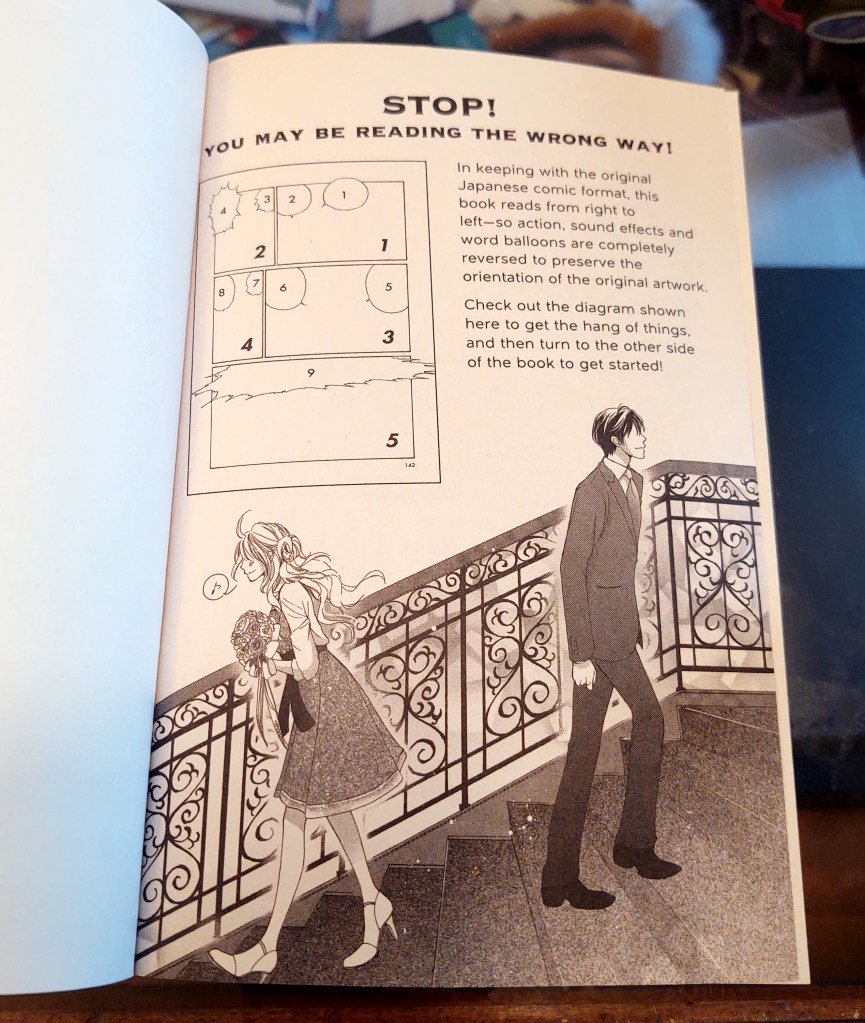
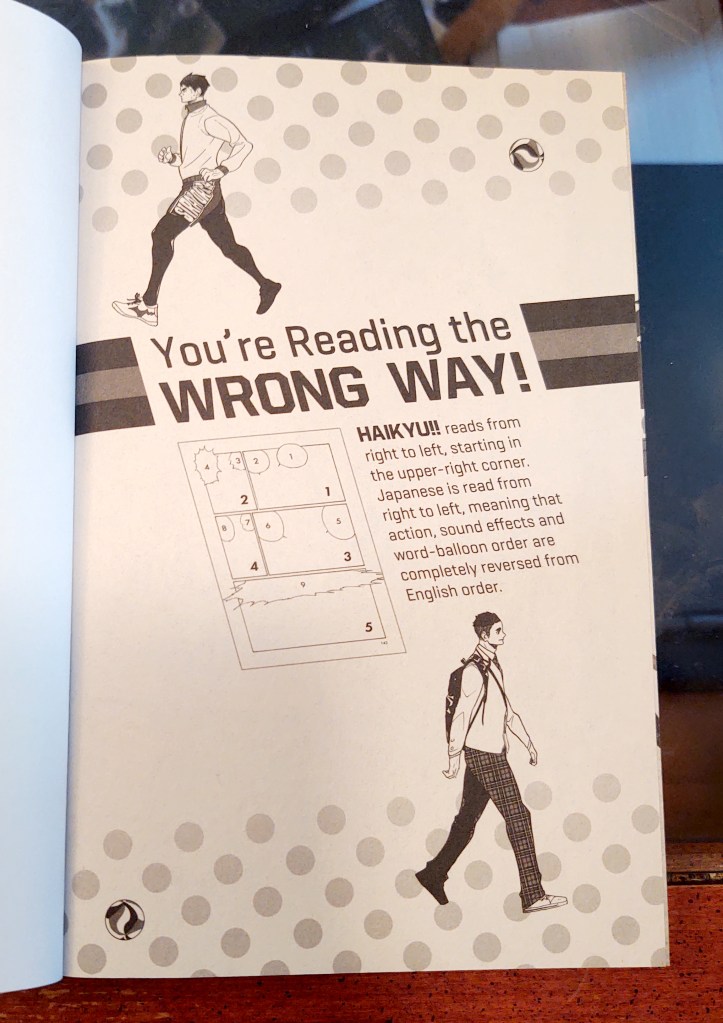
Everyone’s Getting Married vol. 1 (2016) and Haikyu!! vol. 29 (2018) each show two characters heading in different directions, as if to demonstrate that comics can have different reading orders.
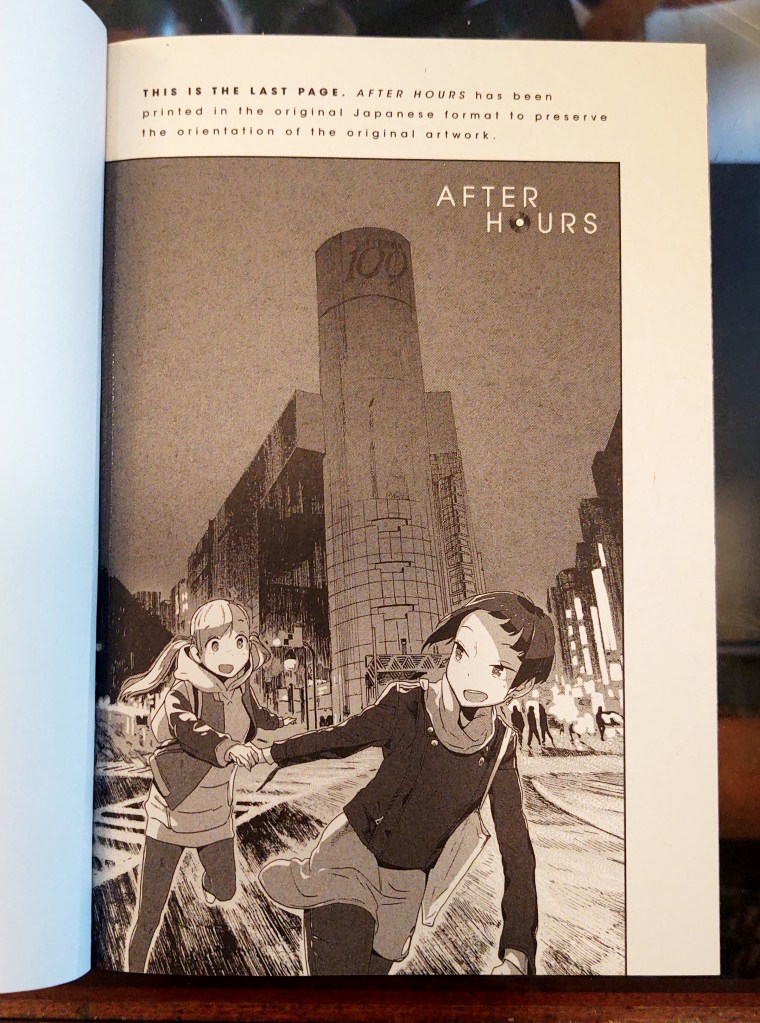
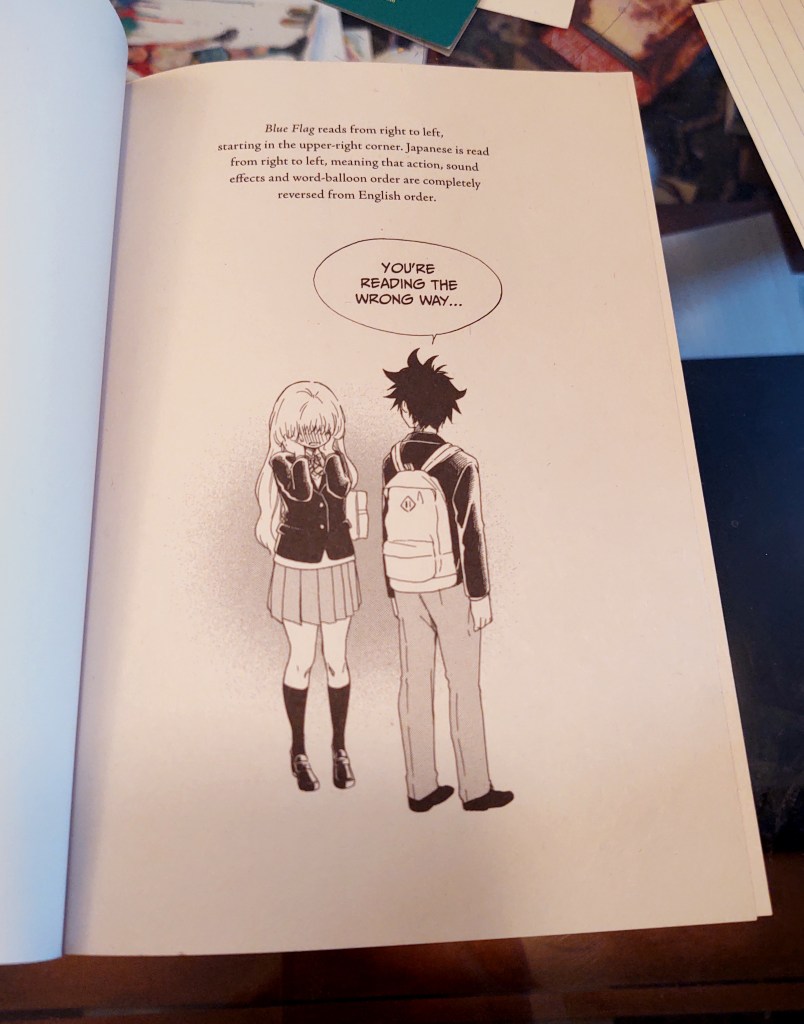
And then there are more subtle and minimalist layouts. After Hours (2017) fills most of the page with an illustration of the main couple rushing through Shibuya Crossing — in the direction of the book’s front cover. Blue Flag (2020) repurposes an image from the comic to create an exchange between characters.
These approaches make sense. TokyoPop is trying to rediscover their audience – their first titles after reopening were Disney licenses and OEL manga. Their LovexLove collection, which includes BL and yuri, genres that will be familiar to long-time manga readers, is just under a year old.
Viz Media, on the other hand, has remained a manga powerhouse with a wide range of series and diverse reader demographics. Someone reaching for Dead Dead Demon’s Dededede Destruction or Junji Ito’s Remina probably knows which side is the front. Someone who heard about a big Shounen Jump hit like Haikyu!! through a friend or an algorithm might not. Viz’s distinction between these kinds of readers is evident in the fact that their Junji Ito hardcovers, SuBLime titles, and more mature series skip do not include a back page warning.
Of course, I know which side of a manga is its cover. And I probably wouldn’t have noticed how Viz addresses new manga readers if I hadn’t noticed that Kodansha and Yen Press don’t. But just like how I love looking at back matter ads for series I’ll never read and events I’ve already missed, I can’t help but appreciate how publishers are addressing audiences who are not me.
Anyway, this little bookshelf exploration made me realize something.
 SpiderHouses